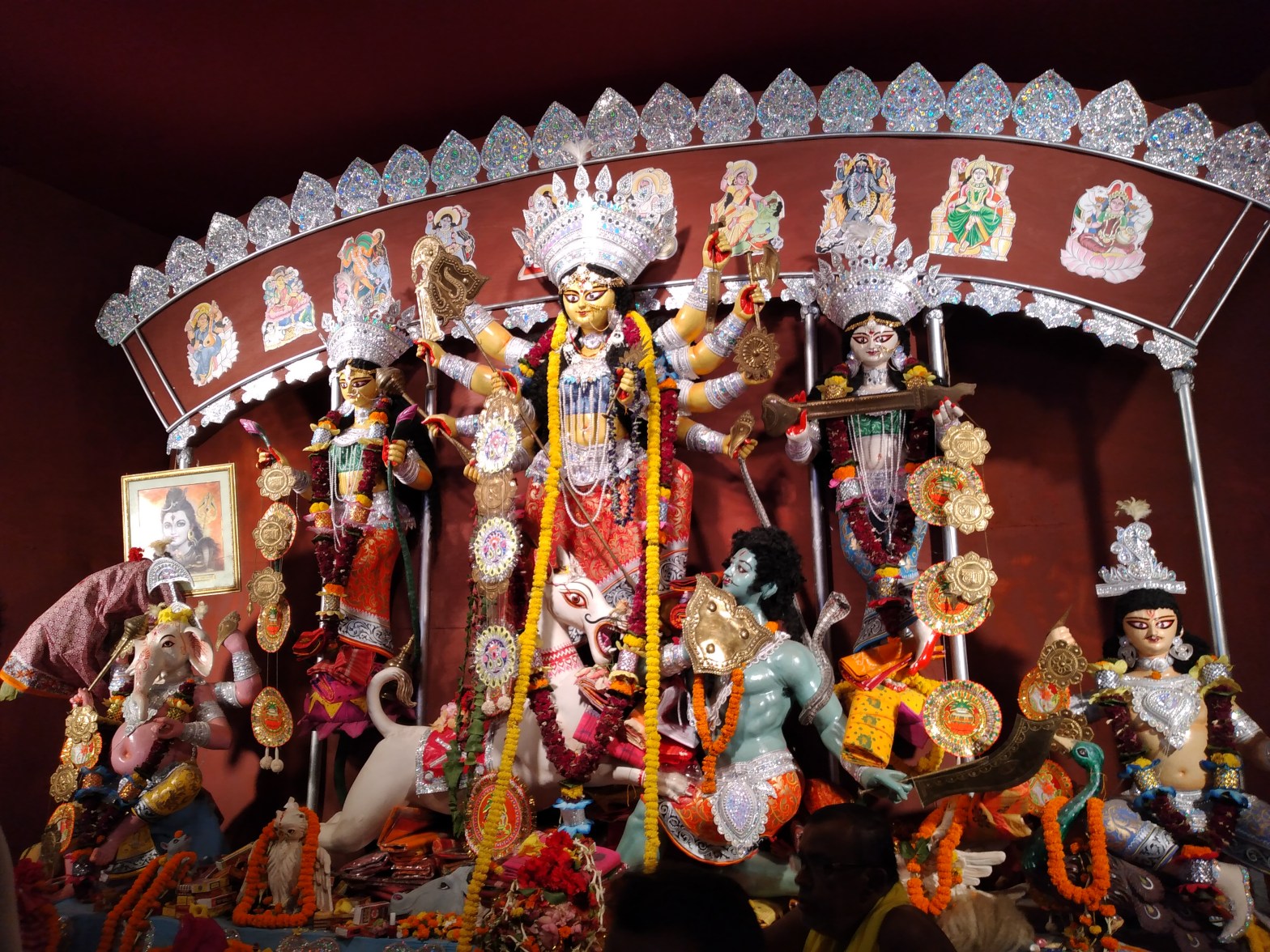
The greatest and most loved festival of West Bengal, Durga Puja bears different meanings for different people. Author Suchismita Ghoshal truly enriched our Clips and Pages family by bringing in a new perspective to look at the grand festivity.
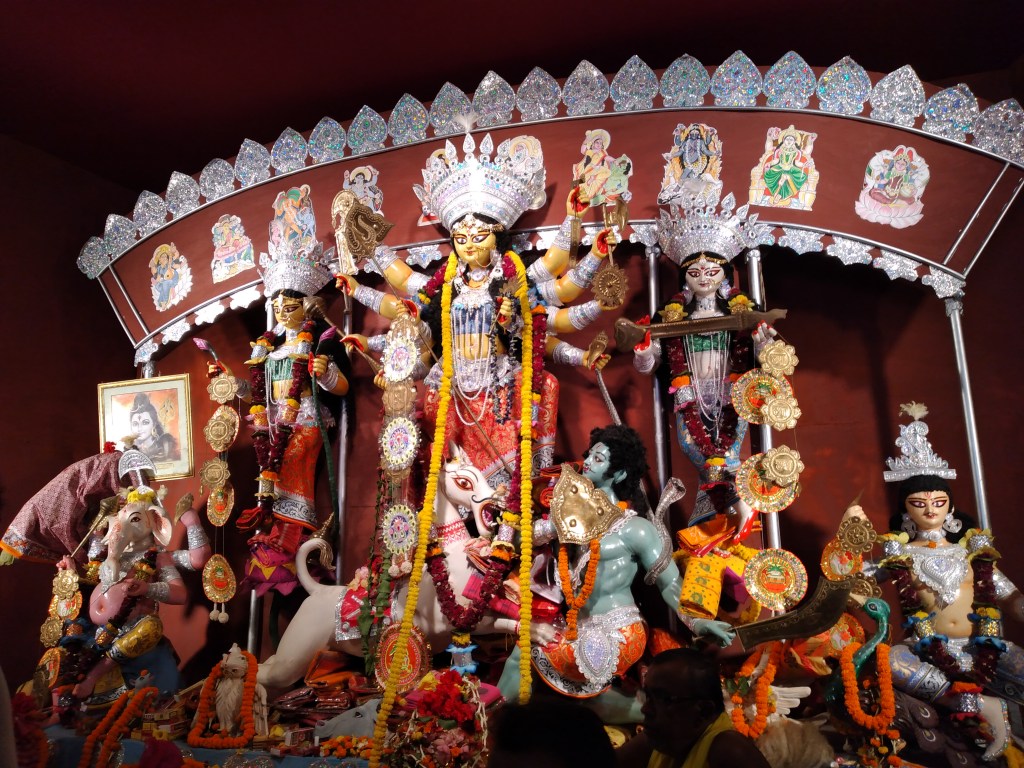
THE VISIONS AND SIGNIFICANCE OF LIBERATION IN ‘DURGA PUJA’ FESTIVITY
As the Durga Puja festival finally sheathes the entire ambience of Bengal into an exuberant phenomena through the bewitchingly captivating faces of deity “Maa Durga”, incandescent lightings, gorgeous pandals, vibrant people, curious eyes of innocent children and incessant assembly of few groups of friends, mostly spend their 360 days out of their hometowns and gobbling of finger-licking cravings, I have found the overwhelming resemblance of the outer expression of liberty through the wholeheartedly celebrated provision. The entire Bengal and its folks forgetting its losses and drawbacks have come forward to welcome ‘Maa’ by showering unimaginable love that they caged for long and pouring the unarticulated heart before ‘Maa’ to receive her cordial blessings.
I have seen the freedom of expression and discrimination-free assemblage in this pious period of time to culminate the real meaning of “Freedom in Unity”. I have witnessed the vibrance of togetherness in lost smiles, the exhilaration of coalescence among friends or family forgetting the long time feuds, the solace in togetherly pandal hopping of families, the uniqueness of trying new food, the carefree distribution of good vibes. Among all these, I have found liberation and peace as well as summed up this extraordinary integrality into a different naming as ‘ The Liberation Festivity’.
The huge amalgamation of million different thoughts and ideologies and the perfect blending of creativities are what give me goosebumps as a separate entity. I feel loved like a prison-free bird; my occupancy-free mind roams around every nook and corner of the scintillating lightened up places and savours the aromatic, divine smell of ‘Dhuno’ [an Indian form of Frankincense] with its deepest core like a therapeutic process.
The 10 days festival carries different meaning and significance for each day with its own rituals performed independently. The last day with the farewell ritual and worshipping ‘Maa’, we are found tear-stricken, soaked with emotional pandemonium and we offer ‘Sindoor’ to our ‘Maa’ with the secret prayers of unending and intact marriage relationship. We bid adieu to ‘Maa’ through the immersion of her huge powerful idolatry in the river near-by with a very eye-catching cultural procession along the way towards river ‘ghat’ from ‘mandap’.
We welcome her royally and bid adieu to her royally. We believe in her inevitable power of unification. Our adverse culture and beliefs tend to take a bow in the enchanted benevolence of our revival of thoughts. People forget rivalry and own the generosity of kinship.
There is saintly attraction in the reverence of chanting the ‘shlokas’ and ‘mantras’ (scriptures) “Rupam dehi, Jayam dehi, Yasho dehi, Dvviso jahi”. [O Devi, Please Grant me (Spiritual) Beauty, Please Grant me (Spiritual) Victory, Please Grant me (Spiritual) Glory and Please Destroy my (Inner) Enemies.] The entire meaning of this ‘stotram’ (ode or eulogy) disintegrates the complex meaning in a simplified form that indicates the prayers for the win of inner divinity over evil spirits and acquiring of victory, positive aspect and celestial glory. If this doesn’t match with the theorems of liberty, what else will?
This vast universe is intact with the spiritual binding of a supreme authority that can never be visible but can be felt if we look around and stimulate our 6th sense to get aware of our position in this entire universe. Worshipping ‘Devi’ (Goddess /Deity) Durga is one of the finest examples of stimulating different senses for a very divine outcome or for the regeneration of noble thoughts to prosper as a wise human being.
I have since my childhood taken this “Durga Puja” festival in different views and perspectives. Childhood innocence found fun in witnessing Devi’s idolatry with parents and eating ice creams and chips in midnight, adolescence took it as a new pleasure of exploring hidden fun like getting attracted towards opposite gender and making oneself dressed like queens to get captivated, then now adulthood finds enthrallment in the regathering of friends and closure of family and as far as I can foresee the mid thirties or mid forties will take it as a refreshment after a monotonous round of a year. So, it’s clearly comprehensible how this festivity is enamoured among us with several different meanings and namings.
Also, it has moulded the enhancement of a festival with a plethora of vibrant shades. To end it with a complementary elegance, all I can say is that if anybody wishes to understand the excellence, nobility and overlordship of liberty with a spiritual touch, they should visit West Bengal in the godly time of Durga Puja Festival for a joyous, wisdomatic, and spiritually wholesome ride.
Author’s Bio
Author Suchismita Ghoshal hails from West Bengal, India. At the age of 23, she has been continuously leaving her footprints in the contemporary literary world. She is an widely published author, internationally reputed bilingual poet, spoken word poet, professional writer, content writer, editor and critic, translator (Bengali, English), performer, communicator and literary influencer. She’s been invited to many international festivals and open mics. Her awards, accolades and achievements not only inspire her more to write but also to influence her through the kindness of her words. Her solo books “Fields of Sonnet”, “Emotions & Tantrums” & “Poetries in Quarantine” are available on Amazon.
 Clips and Pages